

Ask a board to describe the ideal successor to its CEO and, more often than not, what emerges is a portrait of the existing CEO. It includes the commercial instinct, the largest customer relationships, the steadiness with lenders in a difficult year, and any other trait behind the CEO’s success.
This rarely happens by design. The profile drifts toward the person who is leaving, and the process treats the resemblance as evidence of quality.
That is how many companies approach succession, whether the leader is a hired CEO, a founder, or a family heir. They manage it as an exercise in continuity, in which the business is protected by replacing the leader with the closest available equivalent.
The assumption underneath is that the next leader should be a similar, slightly more advanced version of the current one. It feels like the cautious choice, which is why it so rarely gets questioned, and why it can derail a company that otherwise did everything right.
Why resemblance feels like the safe choice
The appeal of resemblance depends on who owns the decision.
In a company led by a hired CEO, the board runs the succession, and directors are judged by how little goes wrong on their watch. Appointing someone cut from the same cloth as the leader who delivered the results is the choice that is hardest to criticize afterward.
In a founder-led company, the board is usually smaller and closer to the person who built the business, and that person’s own identity enters the decision. A successor who resembles the founder validates the route the company took, while a different kind of leader may be perceived as a sign that the route was wrong. Family ownership adds loyalty and gratitude, along with the hope that the founder’s best qualities will reappear in the next generation.
The selection process then locks the assumption in place. Whoever drafts the profile has one reference point, the person who is leaving, so the result is a likeness of this leader. Interviews favor candidates who talk the way the outgoing CEO talks, and references come from people the CEO trusts. By the time a shortlist exists, resemblance has been written into the standards, where it is hard for anyone to challenge.
The same preference for resemblance shapes the pool of internal candidates. Promotion panels reward the habits the senior team already displays.
The executive who challenges the CEO reads as not quite ready, while the one who echoes the CEO reads as a safe option. Internal talent reviews follow the same pattern, and the label “ready now” tends to go to the executive who most resembles the person currently in the job.
Over a decade, the executives who could take the CEO’s chair can come to look alike in experience and habits. The company believes it has several possible successors.
It may have one, repeated several times over.
Behind all of this stands the company’s own success story. A business that grew under one kind of leader has a persuasive explanation for how it got there, which is repeated until it becomes the specification for the next leader. The more successful the tenure, the stronger the pull. The cost is a company that prepares for the last leader’s job rather than the next one.
Strengths belong to the conditions that produced them
A leader’s strengths are formed by the conditions in which that leader worked. Those include the maturity of the market, the cost of capital, the strength of competitors, and what employees expected from their leaders.
A CEO who steered a company through years of cheap capital and steady growth builds sound instincts for expansion, and the same instincts can misleadwhen credit tightens and demand slows.
Likewise, a CEO who excelled at cost discipline in a downturn may carry the wrong reflexes into a period when the business has to invest in a new technology or a new model.
Seen this way, a successor chosen for the same traits is suited to problems that have already been solved. The skills that carried the company through one period remain valuable, but they answer the questions that period asked, while the next brings questions of its own.
A second cost shows up in how successors behave. Research suggests that choosing a similar successor does not guarantee the continuity it promises.
Thomas Hutzschenreuter, Ingo Kleindienst, and Claas Greger examined 177 CEO successions at 76 German listed companies between 1985 and 2007. The more closely a new chief executive resembled the predecessor in career function, industry background, or nationality, the more likely the successor was to sell off businesses the predecessor had acquired within the first two years.
The authors attribute this to a need for distinctiveness, since nobody in that position wants to be seen as interchangeable. A successor chosen this way can end up spending the early years demonstrating how different they are from the predecessor.
When the heir says no, there is no plan B
The family business shows the cost of the assumption most clearly, because there the successor is often chosen by birth. Take a hypothetical family-owned company whose founder has always expected one of his children to succeed him.
The heir is expected to take over by right and to carry on as the founder did, so the family settles who will lead without asking what the company will need from that person.
When the time comes and the heir declines, there is no plan B, because the only plan was a name.
Every option now on the table, whether an outside manager, a minority investor, or a sale, is measured against a standard nobody ever wrote down: does it feel like the founder?
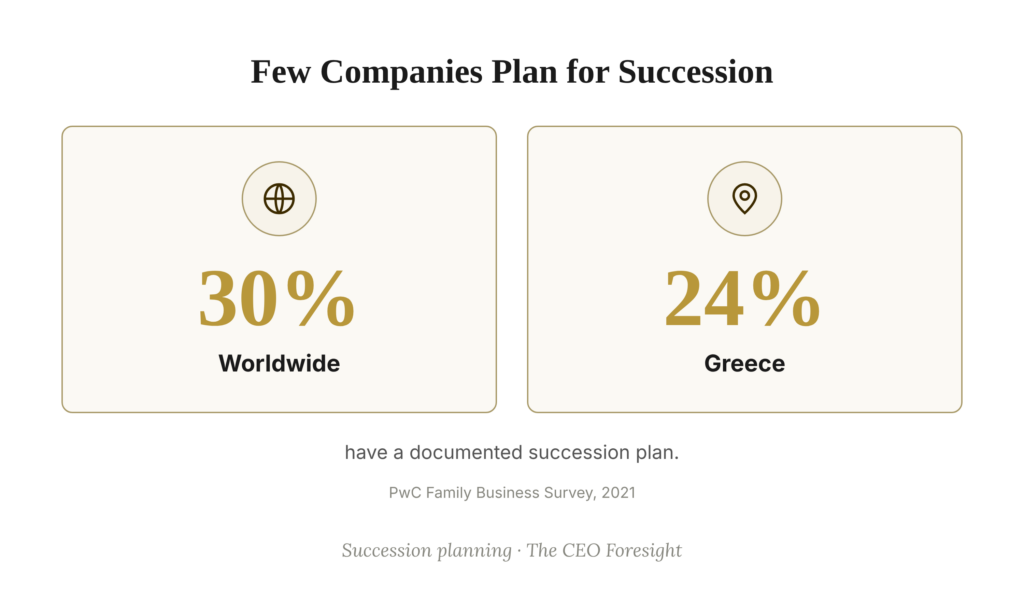
A missing plan B is common, because formal planning is scarcein these companies. PwC’s 2021 Family Business Survey found that only 30% of family businesses worldwide had a documented succession plan. In Greece the figure was 24%.
Even where a plan exists, it often names a successor without describing what the company will need from the role. An heir’s refusal is usually treated as a private family matter. It is also the moment when a company learns whether anyone ever asked what its future would demand.
Choosing without a model
If resemblance is no longer a safe guide, the usual yardstick disappears. A leader with a visible record makes candidates easy to compare.
Without that reference, neither the outgoing CEO nor the candidates in the room can say what the role will demand. The successor will lead in conditions the current CEO never faced, perhaps in a version of the business that does not exist yet.
That leaves the board with candidates and no basis for choosing between them.
Many succession plans fill that gap by default, with the current leader as the model. The plan then describes someone who is about to leave.
Without that model, the plan has little to describe, because the conditions the next leader will face cannot yet be named. Either way, the board ends up with the same unanswered question: what should candidates be measured against?
In our next article, we move from diagnosis to practice: how succession can be prepared for conditions that cannot be predicted.
Sources
Hutzschenreuter, T., Kleindienst, I., and Greger, C. (2018). Seeking distinctiveness through divestments: CEO succession and the effect of demographic similarity on the divestment of predecessor’s investments. Managerial and Decision Economics, 39(4), 462-474. https://doi.org/10.1002/mde.2918
PwC (2021). Family Business Survey 2021, Greece report, March 2021. https://www.pwc.com/gr/en/publications/PwC_FamilyBusinessSurvey2020_Greece.pdf
Founded in 2009, CEO Clubs Greece is the country’s most progressive club for the CEOs and entrepreneurs shaping the future of Greek business and leadership. Its members lead companies representing over 12% of national GDP. CEO Foresight brings their collective thinking to the surface, one question at a time.
Subscribe to CEO Foresight, published every two weeks.