

In our previous article, we showed that the numbers on a CEO’s desk are cracking all at once: earnings that miss real value, ESG scores that contradict each other, and regulators still rewriting the rulebook. None of that has paused a single decision. The real question is what a CEO reaches for while the system keeps arguing with itself.
A small but growing number of companies have stopped waiting for that argument to end. What they have built is not merely a better scorecard. It is what is now called impact-weighted accounting: a way to put a price on the costs that a company’s operations impose, directly or indirectly, on the people and places they affect, costs that have gone unmeasured until now. This data is most useful when a decision is actually being made, rather than in a report a few months into the future.
What impact-weighted accounting is
Financial accounting, ESG ratings, and the disclosure standards converging around the International Sustainability Standards Board, known as the ISSB, all answer the same kind of question: what should a company disclose, and under whose rules?
Impact-weighted accounting answers a different question, one a leadership team asks of itself rather than an outside regulator: if a factory, a sourcing contract, or a product line affects employees, communities, or the environment in a way that never appears on the balance sheet, what is that effect actually worth, in monetary terms?
That figure is then placed next to revenue and profit on an internal ledger, so a leader can weigh two investments in one currency.
This is not a hypothetical exercise for academics. Ethan Rouen and George Serafeim, whose work traces back to Harvard Business School’s Impact-Weighted Accounts Initiative, call the result an impact profit-and-loss statement. Their research (2021) tracked 56 companies, most of them European, that have already put a monetary figure on their impact. The large majority (86%) priced their environmental effects, and about half went further and estimated their employment or social impact.
The infrastructure to do this at scale now exists. The International Foundation for Valuing Impacts, the organization that grew out of the Harvard initiative, describes its methodology as a ‘public good,’ free and available to use for corporate management and portfolio allocation, not just reporting.
It has built a database of nearly 100,000 value factors, the conversion rates that turn a specific impact, like a ton of air pollution or a liter of water drawn from a scarce basin, into a dollar figure, covering more than 430 impact types across over 268 countries and regions.
A company no longer has to invent this math. It has to decide whether to use it.
What it looks like in practice
A well-known and frequent example is Kering. The luxury group that owns Gucci and Balenciaga has run its Environmental Profit and Loss account since 2012, assigning a cost to the carbon, water, land use, and pollution generated across its supply chain, from raw material to store shelf.
Kering states the tool is embedded in strategy and daily operations rather than sitting in a sustainability office, and between 2015 and 2020 it cut EP&L intensity by 33%, driven by supplier and material choices an ordinary profit-and-loss statement would never have flagged as urgent.
Another, more recent example is Novartis. The pharmaceutical company has spent close to a decade putting a monetary value on its medicines’ social impact in countries such as Kenya and South Africa, work that helped found the Value Balancing Alliance in 2019 and led to a partnership with Oxford’s Rethinking Performance consortium. Even so, Novartis still has not published a single aggregated impact-adjusted profit figure. That is not a failure. It shows this is still a work in progress, even for a well-resourced, multi-year effort.
This should not discourage anyone from starting. The workable starting point is narrower than it sounds. Trying to build a fully aggregated figure in one push is how these efforts stall.
What works instead is picking a single externality already tied to a decision on the calendar, like a fleet renewal’s carbon exposure, a sourcing region’s water risk, or a plant closure’s community impact. That number should go to the function that will actually use it, typically the CFO or the strategy office,not to a sustainability team writing a report no one reads before the decision is made.
Kering took over a decade to build its full account. Novartis, eight years in, still has not aggregated a single figure.
That gap between ambition and progress is exactly the case for starting narrow: a single externality, tied to one decision, produces a usable number in months, not years.
The cost of waiting is not hypothetical
Greek shipping is a good example of just how costly it is to wait for outside rules to settle, rather than price a real cost yourself. Shipping is one of the defining industries of the Greek economy, and Greek shipowners control 19.1% of the world’s merchant fleet by tonnage, close to 5,800 vessels carrying more than 458M deadweight tons, according to the Union of Greek Shipowners’ latest annual report. How this fleet prices one specific cost, carbon, shows exactly what that wait can cost.
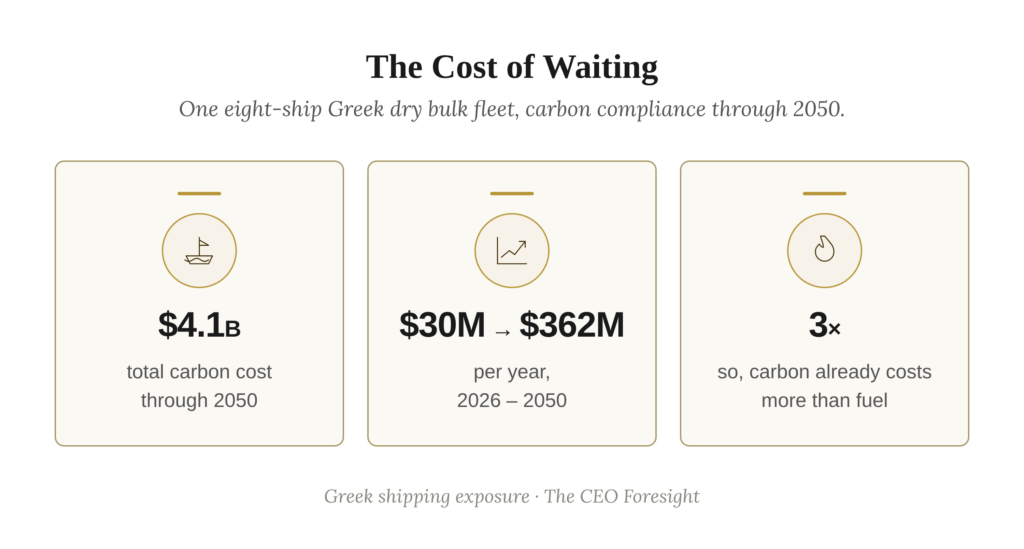
A recent analysis of a single eight-ship Greek dry bulk fleet, now subject to new EU carbon rules for shipping, put its total carbon compliance costs through 2050 at $4.1B, rising from about $30M this year to $362M a year by mid-century. On that fleet, carbon costs already run more than three times higher than fuel costs. The analysts were blunt: this number belongs in this year’s charter negotiations and budgets, not in a note about some future liability. Waiting for cleaner global rules will not make that bill smaller.
The standards fight has not ended, and it does not need to
In the Greek shipping example, carbon pricing is already required by law, so it gets enforced. Most other measurements are not settled the same way, which is why companies and regulators remain confused.
The ISSB, the baseline sustainability disclosure standard, is a good example: 28 countries have adopted it so far, another 12 plan to, and some, like Japan, are already adding stricter rules of their own rather than wait for everyone to agree on one common version. Brussels is still rewriting its own sustainability reporting rules under competitiveness pressure, and the different ESG rating agencies still disagree with each other about as often as they agree.
None of that has to resolve before a leadership team acts. The tools already exist: a named methodology, a working database of value factors, and companies already using them. The only choice left is whether a company’s leaders act now and price these costs themselves, or wait for the system to stop arguing with itself.
Sources
1. Rouen, Ethan, and George Serafeim, “Impact-Weighted Financial Accounts: A Paradigm Shift,” Harvard Kennedy School Mossavar-Rahmani Center — https://www.hks.harvard.edu/centers/mrcbg/programs/growthpolicy/impact-weighted-financial-accounts-paradigm-shift-ethan-rosen
2. ImpactAlpha, “Weighting accounts for impact” — https://impactalpha.com/weighting-accounts-for-impact/
3. International Foundation for Valuing Impacts, Methodology — https://ifvi.org/methodology/
4. International Foundation for Valuing Impacts, “Impact Accounting Leader Release Revolutionizes Accounting for Sustainability in Financial Terms,” October 2024 — https://ifvi.org/news/impact-accounting-leader-release-revolutionizes-accounting-for-sustainability-in-financial-terms/
5. FCLTGlobal, “Environmental Profit & Loss account: a tool for measuring impact” (Kering case study) — https://www.fcltglobal.org/case-study/kering/
6. International Foundation for Valuing Impacts, “Impact Accounting in Practice” — https://ifvi.org/impact-accounting-in-practice/
7. Oxford Saïd Business School, “Novartis: Journey to Impact” case study, 2024 — https://www.sbs.ox.ac.uk/sites/default/files/2024-08/Novartis_journey_to_impact.pdf
8. Union of Greek Shipowners, Annual Report 2025-2026 — https://ugs.gr/media/14186/ugs_annualreport_2526_eng.pdf
9. Sustainable Ships, “Compliance exposure costs of a Greek Dry Bulk fleet until 2050,” 2026 — https://www.sustainable-ships.org/stories/2026/compliance-exposure-greek-bulk-fleet
10. S&P Global Sustainable1, “Where does the world stand on ISSB adoption?,” May 2026 — https://www.spglobal.com/sustainable1/en/insights/research-reports/issb-q2-2026
Founded in 2009, CEO Clubs Greece is the country’s most progressive club for the CEOs and entrepreneurs shaping the future of Greek business and leadership. Its members lead companies representing over 12% of national GDP. CEO Foresight brings their collective thinking to the surface, one question at a time.