

When a valued person resigns, the first reflex is to offer more money to keep them. A counteroffer can be approved by Friday, it often works in the short term, and it feels decisive.
The trouble starts afterward. The person may stay, but the rest of the team can learn what it takes to get a raise, and the higher salary becomes part of the base for good.
That is the core problem with a compensation war.
It raises the price of talent without creating any more of it.
When several employers compete for the same pool of people, the pool does not grow because they bid. Experienced talent takes years to develop, so in the short run supply barely responds to price. Higher offers mostly move the same people between competitors, at a higher cost to all of them.
The more useful question for a CEO is therefore not how much to pay. It is why the talent is scarce in the first place, and whether pay can do anything about it.
The same offer can succeed in one market or one year and fail in another, whether a company operates in a single city or across several countries. The answer depends on the kind of shortage.
Not Every Raise Belongs to the War
It helps to be precise about what the trap actually is, because most salary increases are not part of it.
A raise that comes with a larger remit, a bigger team, or a harder problem is a fair reward for added contribution. A market adjustment that keeps a role in line with what it commands elsewhere is simply paying what the role is worth.
The trap is the premium paid for the same contribution.
It shows up as the counteroffer to someone who has resigned, the retention bonus with no change in role, and the sign-on package that places a new hire above colleagues who have done the same job for years.
These payments buy time and add no new contribution. If the fastest route to a raise is an outside offer, some people will learn to go and get one.
And because people tend to judge their salary by comparison with colleagues, each exception can quietly reset what everyone else considers fair.
Same Pay Decision, Different Shortages
Salaries respond to scarcity, but they cannot remove it. Three situations illustrate how differently that plays out, and where each one can turn into a trap.
The US after the pandemic is a clear case of a temporary shortage. In November 2021, 4.5 million Americans resigned voluntarily in a single month, the highest figure since the US government began tracking it in 2000. That surge put hiring and retention under unusual pressure.
By August 2026, resignations had slowed to 1.9% of employees a month. Higher salaries can bridge a gap like that, so the premiums of the period were not irrational. The trap is permanence: a temporary price built into permanent base salaries, instead of one-off or variable payments that can fall away when the cycle turns.
Japan is the opposite case: a shortage that will not pass. The country’s working-age population peaked in 1995, as Bank of Japan Governor Kazuo Ueda noted in August 2025, and companies now compete for a pool that shrinks every year.
Spring wage talks between unions and employers ended in 2025 with average increases of 5.25%, the highest since 1991. Competition for workers was part of the reason: even smaller companies could not hire without offering more.
But when every employer moves at once, none becomes more attractive than the others, and the pool is no bigger. The trap in a structural shortage is that everyone pays more and nobody wins.
Europe is a third case: a shortage that is uneven. Its labor markets are linked by law, while pay levels remain far apart. The average full-time salary in 2024 was €83,000 in Luxembourg against €18,000 in Greece, with €39,800 for the EU as a whole, according to Eurostat.
Job vacancy rates, the share of all jobs that employers are trying to fill, ranged in the second quarter of 2026 from 4.1% in the Netherlands to 0.5% in Romania.
The European Labour Authority’s 2025 EURES report describes shortages as structural, driven by demographic change, skills gaps, job quality, and limited mobility across borders. It also notes that they often coexist with surpluses elsewhere in Europe.
A raise does not fix a mismatch of skills or place.
Regulation adds a second constraint, and here the trap is visibility. The EU’s pay transparency directive was due to be written into national law by June 2026, and member states are moving at different speeds.
The details vary by country and company size, and may still change, but the direction is the same. Candidates will see more about pay before they join, employers will be limited in asking what someone earned before, and larger companies will report on pay gaps between women and men.
A premium stops being a private arrangement and becomes a more visible one, easier to compare across borders and to match. What still sets an employer apart is whatever competitors cannot match as quickly.
Three shortages, three ways into the same trap: turning a temporary premium into permanent salary, joining a round of raises that every competitor is also making, and creating an advantage that rivals can now see and match.
In each case, money is being asked to solve a problem of supply.
Build Or Buy
If higher offers cannot remove scarcity, the remaining option is to create supply, and that starts with the people entering the workforce. The US offers an early signal.
Stanford’s Digital Economy Lab used payroll data through June 2026 to track workers aged 22 to 25. In the occupations most exposed to AI, their employment is 19% below where it would be had it kept pace with less-exposed peers, mainly because fewer are being hired.
The estimate has been revised with each update of the study, so it is best treated as an indication of direction.
The logic is easy to follow when AI can take over routine junior tasks. The consequence is harder to accept.
Junior roles are where tomorrow’s experienced managers and specialists are formed.
A company that stops building that pipeline is likely to have to buy experienced people from competitors later, and in a tight market that means paying the premium.
The Greek Picture
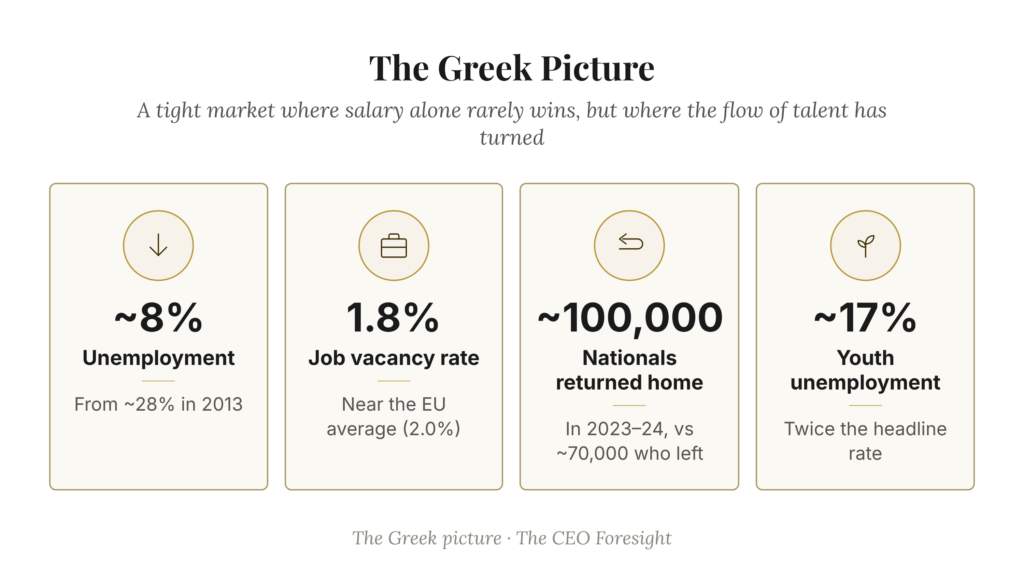
Greece combines several of these pressures at once. Unemployment is now around 8%, according to ELSTAT’s latest figures, down from an annual average of almost 28% in 2013, according to Eurostat. The job vacancy rate, at 1.8% in the second quarter, sits close to the EU average of 2.0%: a tight market, though not an extreme one.
The harder constraint is the salary gap. Against the EU average, and against the countries where Greek professionals can also work, Greece-based companies will rarely win on salary alone.
Greece has already passed its own pay transparency law, with most obligations expected to apply from November, which is likely to make that gap more visible to candidates and employees.
The more promising moves are on the supply side, where the flow of talent has turned.
According to an OECD review of Greek emigrants published in July, close to 100,000 nationals returned home in 2023 and 2024, against roughly 70,000 who left. In 2023, returns exceeded departures for the first time since the economic crisis.
Youth unemployment, at around 17%, is still more than twice the headline rate, which means there is a pool of young people for companies willing to develop them. And inside many organizations there are people whose roles could be widened, and rewarded accordingly, before anyone looks outside.
Companies that came through the crisis years learned to build capability with limited resources, a discipline that suits a strategy built on developing talent.
What this means, Wherever a Company operates
For CEOs responsible for several countries, the three situations are likely to appear in the same week, in different places.
A premium that is right for a scarce skill in one market can be wasted in another, and in Europe it is likely to become visible to candidates and employees alike.
Retention, in this setting, is a market-by-market judgment before it is a group policy.
For leaders of local and family businesses, the same logic holds at a smaller scale. Their rivals are a limited circle of employers competing for a narrow set of skills, so telling a temporary shortage from a permanent one matters even more.
That distinction separates the premiums worth paying from the money better spent developing people the company intends to keep.
None of this means that compensation stops mattering. Salaries below market, or seen as unfair, can still cost a company good people. The aim is to set them deliberately: competitive for the role, tied to scope, and reserved for premiums where scarcity is real and the role is critical.
For a leadership team, the question that matters is where the talent its strategy depends on will come from, and how much of that critical pipeline the company actually controls. The more it controls, the less it has to win by outbidding rivals.
Controlling the supply is only half of the answer, though. The people a company hires, develops, or brings home still decide, every year, whether to stay. What they weigh depends on the market, their generation, and their stage of life, and much of it has little to do with the salary figure. In the next CEO Foresight article from CEO Clubs Greece, we turn to the other half of the answer: the talent value proposition, and what it takes for a company to become a place people choose to stay.
SOURCES
1. U.S. Bureau of Labor Statistics, “Job openings and quits reach record highs in 2021”, Monthly Labor Review, June 2022 — https://www.bls.gov/opub/mlr/2022/article/job-openings-and-quits-reach-record-highs-in-2021.htm
2. U.S. Bureau of Labor Statistics, “Job Openings and Labor Turnover Summary”, August 2026 data, 29 September 2026 — https://www.bls.gov/news.release/jolts.nr0.htm
3. Bank of Japan, Governor Kazuo Ueda, remarks at the Jackson Hole Economic Policy Symposium, 23 August 2025 — https://www.boj.or.jp/en/about/press/koen_2025/data/ko250824a1.pdf
4. JILPT, “2025 Shunto”, Japan Labor Issues, vol. 10, no. 56, 2026 — https://www.jil.go.jp/english/jli/documents/2026/056-03.pdf
5. Eurostat, “Average annual full-time adjusted salary”, 12 November 2025 — https://ec.europa.eu/eurostat/web/products-eurostat-news/w/ddn-20251112-1
6. Eurostat, “Euro area job vacancy rate at 2.1%”, second quarter 2026, 15 September 2026 — https://ec.europa.eu/eurostat/en/web/products-euro-indicators/w/3-15092026-bp
7. European Labour Authority, “EURES report on labour shortages and surpluses 2025”, 11 June 2026 — https://www.ela.europa.eu/en/news/ela-eures-report-flags-persistent-labour-shortages-across-eu
8. Directive (EU) 2023/970 on pay transparency, EUR-Lex — https://eur-lex.europa.eu/eli/dir/2023/970/oj
9. Lewis Silkin, “EU Pay Transparency Directive 2026: no EU-level delay”, 1 July 2026 — https://www.lewissilkin.com/insights/2026/07/01/eu-pay-transparency-directive-2026-employer-compliance
10. Brynjolfsson, Chandar, and Chen, “Canaries in the Coal Mine?”, Stanford Digital Economy Lab, August 2026 update — https://digitaleconomy.stanford.edu/app/uploads/2026/08/Canaries_August2026.pdf
11. ELSTAT, “Labour Force Survey, July 2026”, 31 August 2026 — https://www.statistics.gr/en/statistics/-/publication/SJO02/2026-M07
12. Eurostat, “Unemployment by sex and age, annual data” (une_rt_a) — https://ec.europa.eu/eurostat/databrowser/view/une_rt_a/default/table
13. Ius Laboris, “Greece’s transposition of the EU Pay Transparency Directive”, 2026 — https://iuslaboris.com/insights/greece-pay-transparency-law-employers/
14. OECD, “Talent Abroad: A Review of Greek Emigrants”, 3 July 2026 — https://www.oecd.org/en/publications/a-review-of-greek-emigrants_729f06a5-en.html
15. EKT (National Documentation Centre), summary of the OECD review of Greek emigrants, 22 September 2026 — https://www.ekt.gr/en/news/31387
Founded in 2009, CEO Clubs Greece is the country’s most progressive club for the CEOs and entrepreneurs shaping the future of Greek business and leadership. Its members lead companies representing over 12% of national GDP. CEO Foresight brings their collective thinking to the surface, one question at a time.