

A job offer usually covers the title, the role, the salary, and the benefits.
Much of the rest stays unsaid: how decisions are made, what support managers give, where careers can lead.
Employers and employees picture those things differently. Once people join, the gap shows up as lower engagement, earlier exits, and an open ear for the next offer.
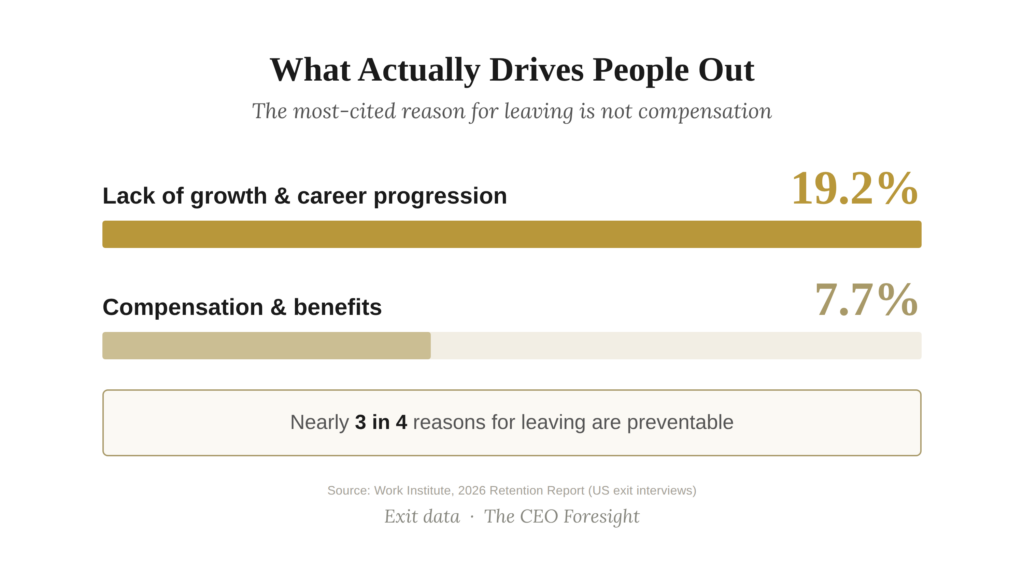
A good part of the solution to the above may be within a company’s reach. In the 2026 report of Work Institute, a US firm that analyzes exit interviews, nearly three quarters of all reasons for leaving fall into categories it classifies as preventable.
With skilled talent in short supply, the tempting next offer that takes talent away tends to be about money, and that is how a compensation war starts. As our previous article showed, such a war is rarely win-win in the long run.
A value proposition that works has to cover more than pay, starting with what is never made explicit.
There is no recipe here: what retains people differs from company to company, and each has to examine its own case.
What can be offered is a path. In many companies the value proposition sits with HR, and leadership steps in mostly when budget is needed. This article suggests it is a strategic challenge that calls for the CEO’s involvement and more deliberate planning than it usually gets.
Every Company Has a Proposition, Designed Or Not
Whatever a company leaves unsaid, people fill in for themselves. A complete value proposition covers everything a company offers in return for people’s work, from pay to daily life on the job to growth.
Gartner’s definition puts the weight on perception: the value employees perceive they gain through employment.
A company shapes that value by what it intends, but employees ultimately define it, each through their own lens.
That perception takes shape largely after the start date, and the evidence suggests this is also where many exits begin.
The same Work Institute 2026 report links early exits to role expectations, workload, and manager support, all of which surface only once the job has started.
A related signal comes from Greece, about something no job offer can show. In Randstad’s Workmonitor 2025, 52% of workers there said they had quit a job because of a toxic work environment, against 44% globally. So people judge a proposition by what they live after the start date, whatever the offer said.
Who looks after the implementation of the proposition once the offer is signed? In Mercer’s Global Talent Trends 2026 research, HR leaders rank improving employee experience and building a strong value proposition as their top people priority.
Yet most of what people experience is decided above HR: who holds decision rights, how large a team a manager can lead well, what a promotion requires, and where leadership attention goes.
That is why it needs a CEO who owns it, and why the question shifts from what to offer to what to keep delivering.
What Makes People Leave, and What Keeps Them
To know what to keep delivering, a CEO needs to know what weighs most in people’s decision to stay or leave.
The usual lists, from remuneration and benefits to growth, culture, flexibility, and values, show what an offer can contain.
They say little about which items matter most to whom, and at which stage of their tenure. Exit data helps. In the Work Institute 2026 report, the most cited reason for leaving is a lack of growth and career progression, at 19.2% of exits. Work-life balance and the way managers lead, support, and communicate each account for a bigger share than compensation and benefits, which stand at 7.7%.
The reasons also shift with tenure, according to Work Institute. Newcomers weigh role clarity, workload, and manager support most.
In the middle years, development and consistent leadership matter more. Long-serving employees care more about trust, fairness, and where leadership is taking the company.
A company’s own exit interviews reveal more than any benchmark, though they capture only what people choose to say on the way out. Talking with those who stay completes the picture.
Research on job embeddedness, first set out in 2001, finds that three bonds hold a person in place: ties to colleagues and teams, fit with the work and the organization, and what they would give up by leaving.
A 2012 meta-analysis linked embeddedness to lower turnover, both intended and actual.
These bonds deepen only with time, through shared projects, growing responsibility, and standing earned along the way.
A competitor can match a salary quickly. It cannot match what a person has already built inside the company.
This is one reason the early period deserves attention: the gap between promise and reality can open soon after the start, while the bonds that hold people take time to form.
In short, a company keeps delivering four things: a path to grow, managers who lead well, a workload people can sustain, and time to build ties, with pay as the floor under all of them.
Where to Start: Three Questions
Three questions make it specific enough to guide decisions for meaningful propositions.
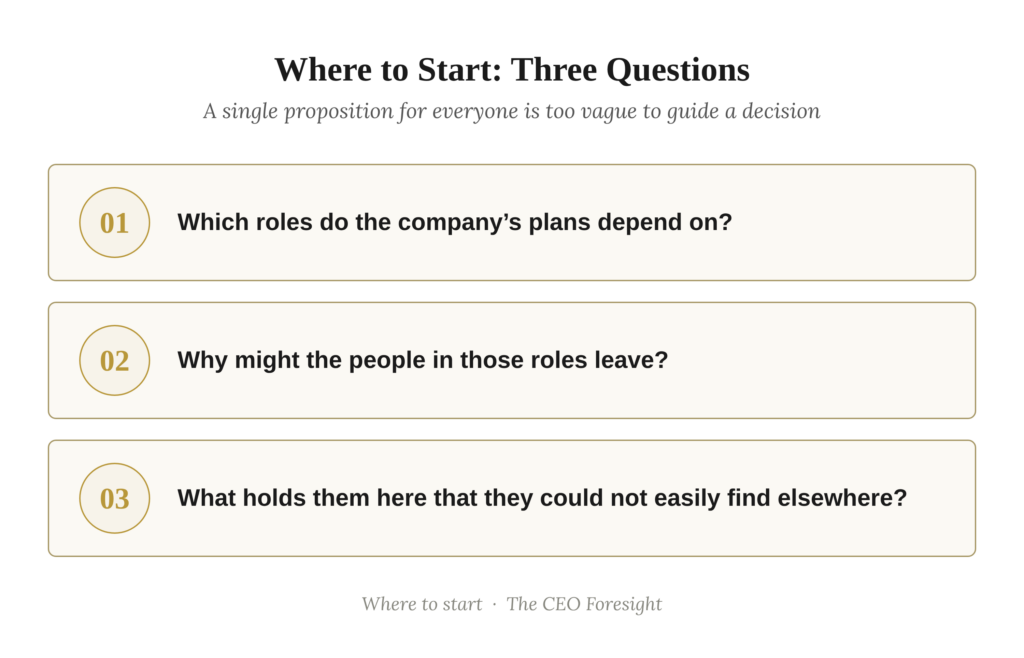
Which roles do the company’s plans depend on?
The obvious answers are the scarce experts, the senior leaders, and the people being grown into those roles.
A less obvious one is the middle manager, because the proposition is put into practice through them: they assign the work, give feedback, and decide whether the development conversation happens.
Yet manager engagement is sliding. Gallup’s 2026 global report shows it falling from 31% in 2022 to 22% in 2025, while non-managers barely moved, from 20% to 19%.
Gallup’s figures cover managers at every level, and engagement is not the same as leaving. Still, the trend is a warning sign for the people who carry the proposition.
Why might the people in those roles leave?
Often because of a gap between what was promised and what they find, and the gap differs by level.
For example, senior hires may come for scope and autonomy, and go when the scope narrows or the autonomy never arrives. Middle managers may join for a bigger remit, and move on when they are asked to develop their teams while their own path stays unclear. Junior hires may come for learning and a future, and go when the first year offers neither.
What holds them here that they could not easily find elsewhere?
This is the value a competitor cannot match with a higher salary, and each company has to name its own.
For example, it may be direct access to decisions, real responsibility early on, or a manager who invests in people’s growth. Many of these cost attention more than budget. They are hard to copy because they depend on leaders keeping them up year after year, not on anyone’s ability to pay.
From Answers To Action
The three questions are strategic, and their answers sit with the CEO. They count only when they reach daily practice, which takes a few deliberate commitments.
The middle layer first.
Managers in it are asked to give others what they may not receive themselves: clear decision rights, a development path of their own, recognition, and a team size that leaves time to lead.
A proposition that starts with this layer is more likely to reach everyone below it. One way to start is to ask the managers of the critical teams which decisions they cannot make today, and what their own next step looks like.
Fewer promises, reliably kept.
A value proposition rests on a few clear commitments beyond pay, especially for the roles that matter most, stated at hiring and revisited regularly afterward.
A company that cannot promise promotions, for example, can still promise people a clear view of where they stand and what could come next, reviewed twice a year. It helps to put the two or three commitments for each critical role in plain words, and to check that the hiring manager is ready to keep them.
Promises checked against reality.
Comparing what people hired in the past year were told with what they found after six months shows where the gap opens.
Exit interviews, and conversations with people who stay, show how it varies by level and tenure. Together they give the CEO a view of the proposition as it is lived, not as it was written.
The gap is then worth reviewing with the leadership team, rather than leaving it with HR.
A job offer is written once. A value proposition that retains talent takes a strategic view, an honest look through employees’ eyes, and regular checks against reality.
A question worth taking to the next leadership meeting: for the roles the company’s plans depend on, what was promised, and what are those people finding?
SOURCES
1. Gartner, “Redefining the Employee Value Proposition (EVP)”, undated. https://www.gartner.com/en/human-resources/trends/evp-design-template
2. Work Institute, “2026 Retention Report”, 2026. https://email.workinstitute.com/hubfs/2026%20Retention%20Report/WorkInstitute_RetentionReport_2026.pdf
3. Randstad, “Workmonitor 2025” global results, press release, 21 January 2025. https://www.randstad.com/press/2025/work-life-balance-tops-pay-randstads-workmonitor-reveals/
4. Randstad Greece, “Randstad Workmonitor 2025: οι εργαζόμενοι στην Ελλάδα επαναπροσδιορίζουν τις προτεραιότητές τους”, press release (in Greek), 11 February 2025. https://www.randstad.gr/h-randstad/deltia-typou/deltia-typoy/randstad-workmonitor-2025-oi-ergazomenoi-stin-ellada/
5. Mercer, “Global Talent Trends 2026”, employee value proposition insight, 2026. https://www.mercer.com/en-gb/insights/workforce-and-careers/war-for-talent/compelling-employee-value-proposition-new-talent-advantage-in-age-of-ai/
6. Mitchell, T. R., Holtom, B. C., Lee, T. W., Sablynski, C. J., and Erez, M., “Why People Stay: Using Job Embeddedness to Predict Voluntary Turnover”, Academy of Management Journal, vol. 44, no. 6, 2001, pp. 1102 to 1121. https://doi.org/10.2307/3069391
7. Jiang, K., Liu, D., McKay, P. F., Lee, T. W., and Mitchell, T. R., “When and How Is Job Embeddedness Predictive of Turnover? A Meta-Analytic Investigation”, Journal of Applied Psychology, vol. 97, 2012, pp. 1077 to 1096. https://doi.org/10.1037/a0028610
8. Gallup, “State of the Global Workplace 2026”, 2026. https://www.gallup.com/workplace/349484/state-of-the-global-workplace.aspx
Founded in 2009, CEO Clubs Greece is the country’s most progressive club for the CEOs and entrepreneurs shaping the future of Greek business and leadership. Its members lead companies representing over 12% of national GDP. CEO Foresight brings their collective thinking to the surface, one question at a time.
Subscribe to CEO Foresight, published every two weeks.